<?xml version="1.0" encoding="utf-8"?><feed xmlns="http://www.w3.org/2005/Atom" ><generator uri="https://jekyllrb.com/" version="4.3.4">Jekyll</generator><link href="http://localhost:4000/feed.xml" rel="self" type="application/atom+xml" /><link href="http://localhost:4000/" rel="alternate" type="text/html" /><updated>2026-08-05T14:57:19-04:00</updated><id>http://localhost:4000/feed.xml</id><title type="html">Keycube</title><subtitle>The keycube is a kind of keyboard. A cubic device dedicated to text entry.</subtitle><entry xml:lang="en"><title type="html">新年快乐</title><link href="http://localhost:4000/library/2026/02/17/newyear-lib-tianjinbinhai.html" rel="alternate" type="text/html" title="新年快乐" /><published>2026-02-17T03:30:00-05:00</published><updated>2026-02-17T03:30:00-05:00</updated><id>http://localhost:4000/library/2026/02/17/newyear-lib-tianjinbinhai</id><content type="html" xml:base="http://localhost:4000/library/2026/02/17/newyear-lib-tianjinbinhai.html"><![CDATA[<p>Happy <a href="https://en.wikipedia.org/wiki/Chinese_New_Year">Chinese New Year</a>! 
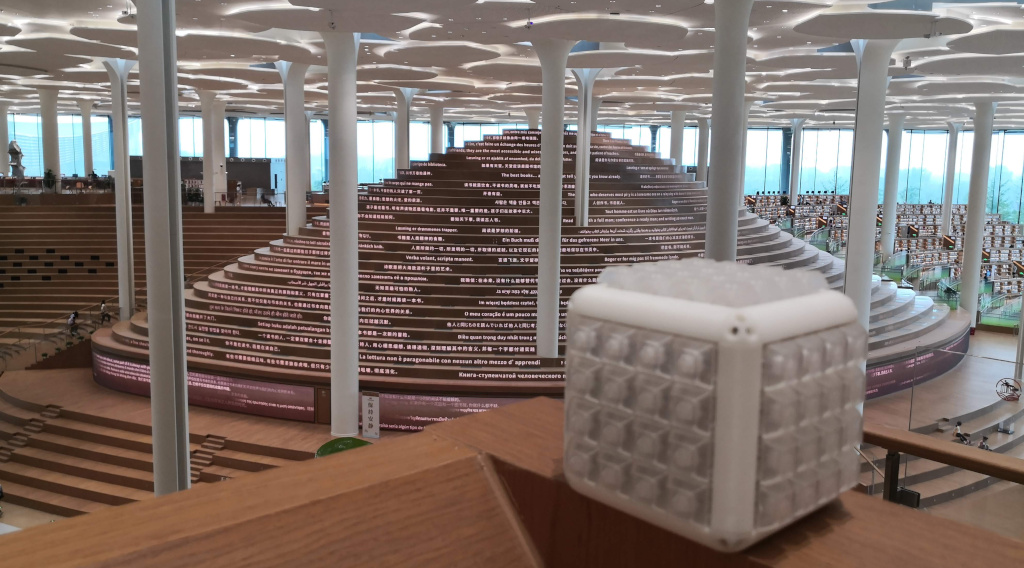
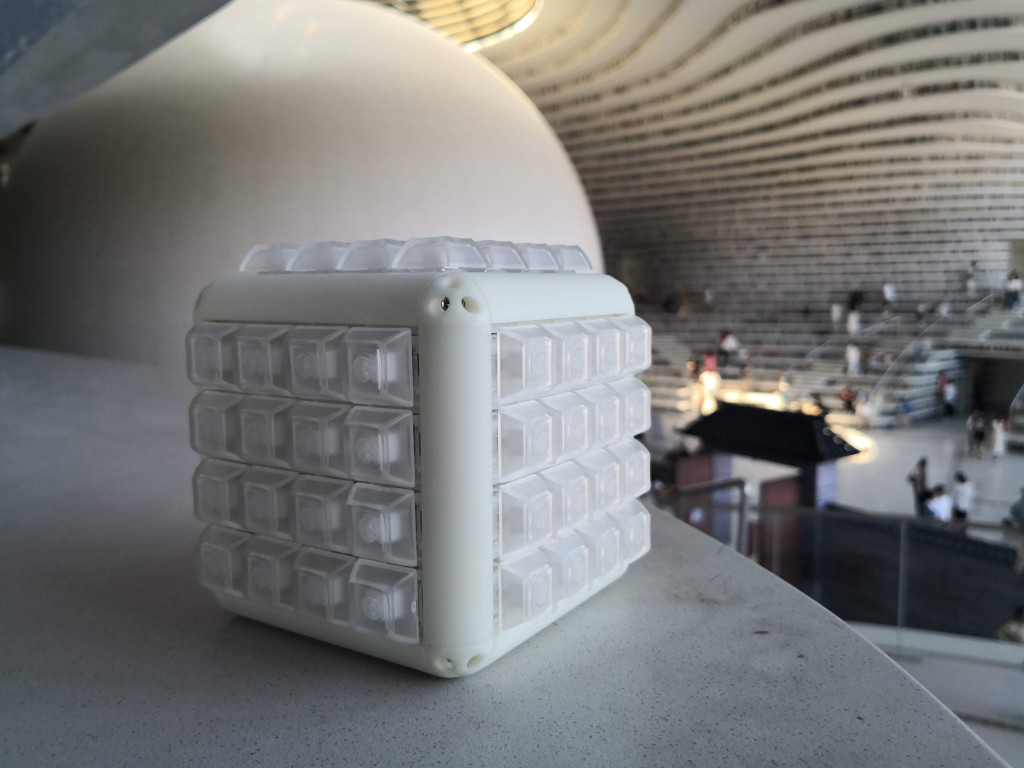
What better way to kick off the <strong>Year of the Horse</strong> than with the <a href="/library/2025/09/17/lib-beijing.html">traveling keycube</a> touring China! For its second stop, in mid-2024, the keycube visited the beautiful and iconic <a href="https://en.wikipedia.org/wiki/Tianjin_Binhai_Library">Tianjin Binhai Library</a>.</p>

<p><img src="/assets/img/blog/lib_tianjinbinhai.jpg" alt="A photograph of the keycube inside the library" /></p>

<p>And so continues the <strong>keycube</strong>’s <a href="/blog/topic/library/">globetrotting tour of libraries</a>!</p>]]></content><author><name>Damien</name></author><category term="library" /><summary type="html"><![CDATA[Happy Chinese New Year! What better way to kick off the Year of the Horse than with the traveling keycube touring China! For its second stop, in mid-2024, the keycube visited the beautiful and iconic Tianjin Binhai Library.]]></summary></entry><entry xml:lang="en"><title type="html">3D Shape, 3D Viewer!</title><link href="http://localhost:4000/update/2026/01/29/threedviewer.html" rel="alternate" type="text/html" title="3D Shape, 3D Viewer!" /><published>2026-01-29T07:30:00-05:00</published><updated>2026-01-29T07:30:00-05:00</updated><id>http://localhost:4000/update/2026/01/29/threedviewer</id><content type="html" xml:base="http://localhost:4000/update/2026/01/29/threedviewer.html"><![CDATA[<p>True to its 3D nature, the keycube can now be explored from every angle directly on the <a href="https://keycube.org">homepage</a>! An <strong>interactive three-dimensional viewer</strong>, initially <a href="https://github.com/keycube/k3web3d">prototyped</a> by <strong>Nolann Moisis</strong> as part of an academic project (autumn 2024), has been simplified and embedded into the website.
This implementation is powered by the JavaScript library <a href="https://threejs.org">three.js</a>.</p>

<p>This is more than just a visual upgrade, it will serve as the foundation for future ways to experience the keycube and its features. Whether we are a potential user, a tech enthusiast, or simply curious, the viewer will give us a deeper appreciation for its thoughtful design and functionality.</p>]]></content><author><name>Damien</name></author><category term="update" /><summary type="html"><![CDATA[True to its 3D nature, the keycube can now be explored from every angle directly on the homepage! An interactive three-dimensional viewer, initially prototyped by Nolann Moisis as part of an academic project (autumn 2024), has been simplified and embedded into the website. This implementation is powered by the JavaScript library three.js.]]></summary></entry><entry xml:lang="en"><title type="html">Letters in Light</title><link href="http://localhost:4000/update/2025/12/27/neonled.html" rel="alternate" type="text/html" title="Letters in Light" /><published>2025-12-27T11:00:00-05:00</published><updated>2025-12-27T11:00:00-05:00</updated><id>http://localhost:4000/update/2025/12/27/neonled</id><content type="html" xml:base="http://localhost:4000/update/2025/12/27/neonled.html"><![CDATA[<p>To close the year on a <em>lighter</em> note, here is a small fabrication made in December.</p>

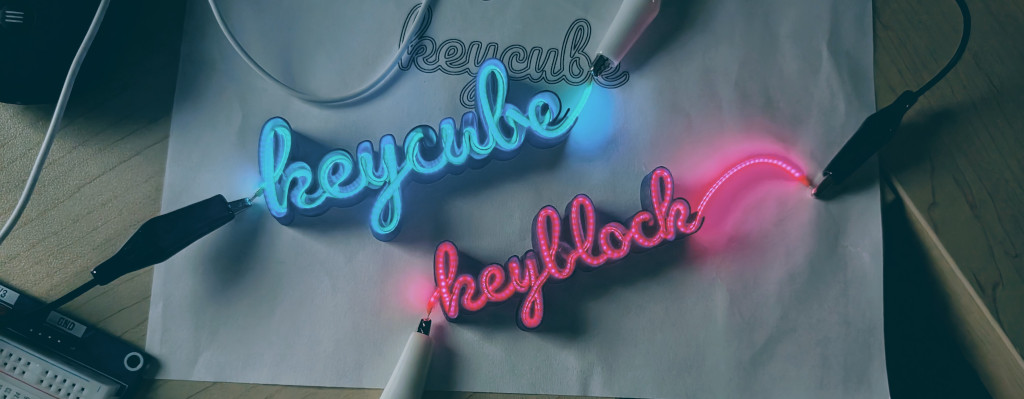
<p><img src="/assets/img/blog/k3kbk_neonsign.jpg" alt="A photograph of small neon-like signs" /></p>

<p>Two tiny <strong>neon-style</strong> signs were built using simple 3D-printed supports and flexible LED filaments. They are not meant as finished prototypes, but rather as a quick exploration of light, form, and atmosphere, which fits well with the end-of-year mood.</p>

<p>Looking ahead, this kind of neon-like lighting could naturally find its way into the keycube itself, especially along the edges of its structure. Integrated light could help emphasize the cubic geometry, provide visual feedback, or simply add a gentle presence to the device.</p>]]></content><author><name>Damien</name></author><category term="update" /><summary type="html"><![CDATA[To close the year on a lighter note, here is a small fabrication made in December.]]></summary></entry><entry xml:lang="en"><title type="html">The cube rolled… and landed at keycube.org</title><link href="http://localhost:4000/update/2025/11/30/domain.html" rel="alternate" type="text/html" title="The cube rolled… and landed at keycube.org" /><published>2025-11-30T09:30:00-05:00</published><updated>2025-11-30T09:30:00-05:00</updated><id>http://localhost:4000/update/2025/11/30/domain</id><content type="html" xml:base="http://localhost:4000/update/2025/11/30/domain.html"><![CDATA[<p>The keycube finally has its own place on the internet, and it feels great to say it: the project now lives at <strong><a href="https://keycube.org">keycube.org</a></strong>.</p>

<p>Nothing else changes behind the scenes. The site is still hosted on <a href="https://docs.github.com/en/pages">GitHub Pages</a>, and the classic <a href="https://keycube.github.io">keycube.github.io</a> link continues to work just fine. It now redirects smoothly to the new domain, so you can use whichever link you prefer.</p>

<p>This new domain makes the project easier to find, easier to share and, honestly, a bit more real. It’s a small step, but it feels like an important one in the journey of the keycube.</p>]]></content><author><name>Damien</name></author><category term="update" /><summary type="html"><![CDATA[The keycube finally has its own place on the internet, and it feels great to say it: the project now lives at keycube.org.]]></summary></entry><entry xml:lang="en"><title type="html">Bonjour, hi!</title><link href="http://localhost:4000/update/2025/10/03/french.html" rel="alternate" type="text/html" title="Bonjour, hi!" /><published>2025-10-03T17:30:00-04:00</published><updated>2025-10-03T17:30:00-04:00</updated><id>http://localhost:4000/update/2025/10/03/french</id><content type="html" xml:base="http://localhost:4000/update/2025/10/03/french.html"><![CDATA[<p>We’re excited to announce that the official <strong>keycube</strong> website is now fully available in both <strong>French</strong> and <strong>English</strong>.</p>

<p>This step feels natural, because the keycube itself was born at the crossroads of two French-speaking worlds: <strong>France</strong> and <strong>Quebec</strong>. The first prototypes, ideas, and discussions that shaped the project grew out of research conducted in these two regions. Having the website in both languages is a way of recognizing that history and keeping a strong connection with the communities that helped give life to the keycube.</p>

<p>At the same time, sharing the site in English opens the door to a wider international audience, making it easier for more people to discover the project, learn from it, and contribute.</p>

<p>The keycube is about openness: open research, open-source software and hardware, and open sharing of ideas. Making the site accessible in both French and English is one more step in that direction.</p>]]></content><author><name>Damien</name></author><category term="update" /><summary type="html"><![CDATA[We’re excited to announce that the official keycube website is now fully available in both French and English.]]></summary></entry><entry xml:lang="en"><title type="html">The Wandering Keycube: Library Edition</title><link href="http://localhost:4000/library/2025/09/17/lib-beijing.html" rel="alternate" type="text/html" title="The Wandering Keycube: Library Edition" /><published>2025-09-17T17:00:00-04:00</published><updated>2025-09-17T17:00:00-04:00</updated><id>http://localhost:4000/library/2025/09/17/lib-beijing</id><content type="html" xml:base="http://localhost:4000/library/2025/09/17/lib-beijing.html"><![CDATA[<p>Some devices are meant to stay on a desk. The <strong>keycube</strong>, however, has other plans. Just like the famous <a href="https://en.wikipedia.org/wiki/Travelling_gnome">travelling gnome</a>, a quirky idea beautifully depicted in the French film <a href="https://en.wikipedia.org/wiki/Am%C3%A9lie">Amélie</a>, the keycube is setting off on its own journey around the world. Its mission? To pop up in libraries far and wide, posing for photos in these temples of books and ideas.</p>

<p>Why libraries, you ask? Because the keycube is all about text. And what better companions for a text-entry device than shelves upon shelves of stories, poems, and knowledge? Each visit turns into a playful meeting between technology and culture, where the little cube feels right at home among the pages.</p>

<p>The first stop in this adventure: the new <a href="https://en.wikipedia.org/wiki/Beijing_Library">Beijing Library</a> in Tongzhou, Beijing. It officially opened its doors in December 2023, and by mid-2024, just six months later, I had the good fortune to visit. The architecture is nothing short of stunning: vast, luminous, and inspiring. Against this backdrop, the keycube looked perfectly at ease, as if it too had come to read, write, and dream.</p>

<p><img src="/assets/img/blog/lib_beijing.jpg" alt="A photograph of the keycube inside the library" /></p>

<p>And so begins the <strong>keycube</strong>’s globetrotting tour of libraries. Who knows where it will pop up next? Maybe in your favorite library, so keep an eye out!</p>]]></content><author><name>Damien</name></author><category term="library" /><summary type="html"><![CDATA[Some devices are meant to stay on a desk. The keycube, however, has other plans. Just like the famous travelling gnome, a quirky idea beautifully depicted in the French film Amélie, the keycube is setting off on its own journey around the world. Its mission? To pop up in libraries far and wide, posing for photos in these temples of books and ideas.]]></summary></entry><entry xml:lang="en"><title type="html">Keycu..ddly</title><link href="http://localhost:4000/update/2024/11/28/plush.html" rel="alternate" type="text/html" title="Keycu..ddly" /><published>2024-11-28T15:00:00-05:00</published><updated>2024-11-28T15:00:00-05:00</updated><id>http://localhost:4000/update/2024/11/28/plush</id><content type="html" xml:base="http://localhost:4000/update/2024/11/28/plush.html"><![CDATA[<p>Introducing the keycu…ddly, well, a <strong>plush</strong> keycube!</p>

<p>This iteration softens the hard edges of the original cubic keyboard, transforming it into something more inviting, friendly, and playful. Crafted from textile and conductive fabric, this exploratory version feels more like a stuffed toy than a traditional input device. Yet, the plush keycube retains its functionality, featuring five active faces with compact 2x2 matrices, for a total of 20 switches.</p>

<p>This first cuddly prototype, conceived by <strong>Emeline Pellan</strong> as part of an academic project (winter 2024), blurs the lines between technology and comfort, offering a captivating mix of functionality and tactile exploration. It serves as a tool, a toy, and a thought experiment, demonstrating how design can gently redefine the boundaries between human and machine.</p>

<p>For technical details, including fabrication models, dimensions, and a list of hardware components, visit the dedicated GitHub <a href="https://github.com/keycube/k3Plush">repository</a>.</p>]]></content><author><name>Damien</name></author><category term="update" /><summary type="html"><![CDATA[Introducing the keycu…ddly, well, a plush keycube!]]></summary></entry><entry xml:lang="en"><title type="html">Let there be light</title><link href="http://localhost:4000/update/2024/10/29/light.html" rel="alternate" type="text/html" title="Let there be light" /><published>2024-10-29T10:00:00-04:00</published><updated>2024-10-29T10:00:00-04:00</updated><id>http://localhost:4000/update/2024/10/29/light</id><content type="html" xml:base="http://localhost:4000/update/2024/10/29/light.html"><![CDATA[<p>The keycube is an innovative interface with <strong>backlit keys</strong> arranged around a cube, and managing its lighting can create dynamic and engaging visual experiences. A small development library was designed to simplify the management of these lighting effects while offering a wide range of animations.</p>

<p>Predefined effects like <strong>rainbow transitions</strong>, where colors smoothly move across the cube, and the <strong>breathing effect</strong>, where light intensity gently fluctuates, help create calming or engaging visual feedback. Another popular effect, <strong>the ripple</strong>, triggers a wave of light across the keys when a single key is activated.</p>

<p>This library provides an intuitive and flexible way to control the keycube’s lighting, with easy customization options for colors and transitions. It opens up exciting possibilities for enhancing interactions with this unique interface.</p>

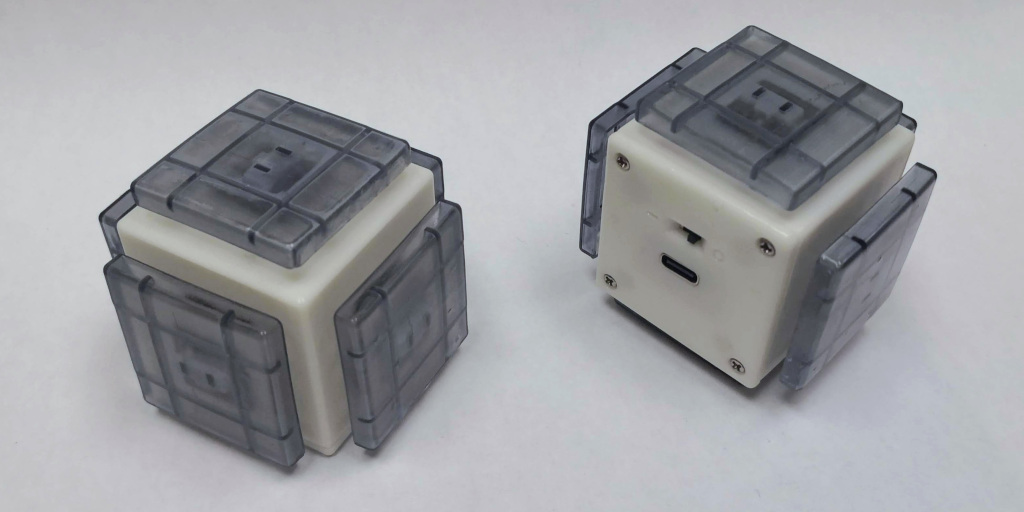
<p>For more technical details about the light management library developed by <strong>Thibaut Breton</strong> as part of an academic project (in fall 2023), visit the dedicated GitHub <a href="https://github.com/keycube/lightManager">repository</a>.</p>]]></content><author><name>Damien</name></author><category term="update" /><summary type="html"><![CDATA[The keycube is an innovative interface with backlit keys arranged around a cube, and managing its lighting can create dynamic and engaging visual experiences. A small development library was designed to simplify the management of these lighting effects while offering a wide range of animations.]]></summary></entry><entry xml:lang="en"><title type="html">A baby is born</title><link href="http://localhost:4000/update/2024/09/28/bbk3.html" rel="alternate" type="text/html" title="A baby is born" /><published>2024-09-28T09:00:00-04:00</published><updated>2024-09-28T09:00:00-04:00</updated><id>http://localhost:4000/update/2024/09/28/bbk3</id><content type="html" xml:base="http://localhost:4000/update/2024/09/28/bbk3.html"><![CDATA[<p>The keycube family is expanding! Introducing the <strong>baby keycube</strong> (<strong>bbk3</strong>), a compact version of the original, featuring just one key per face. But it’s not just one device, it’s a pair of twins! These two units magnetically snap together to form a single, versatile controller.</p>

<p><img src="/assets/img/blog/bbk3_two.jpg" alt="A photograph of two baby keycubes" /></p>

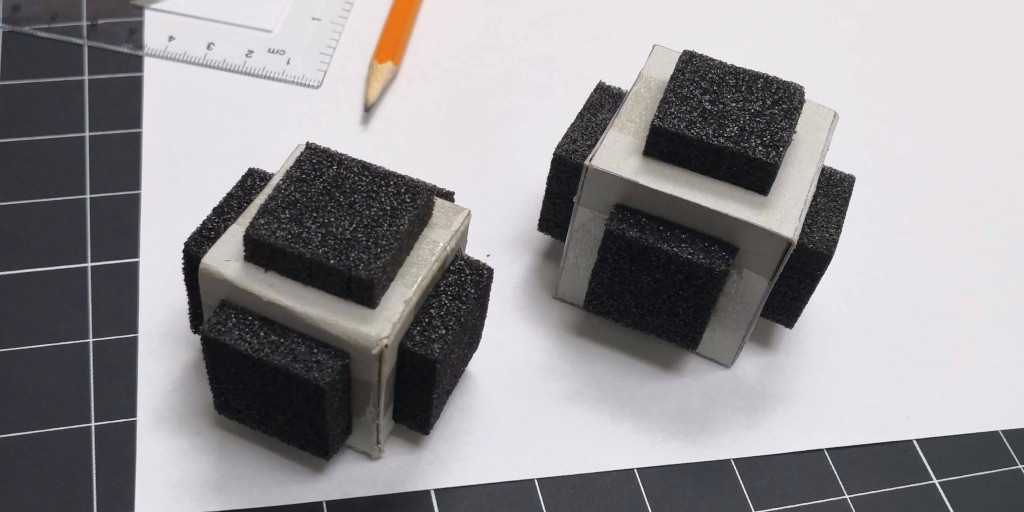
<p>The first functional prototypes were developed by <strong>Adrien Cartelot</strong> as part of an academic project (autumn 2023). Since then, the 3D models have been refined and simplified using <a href="https://openscad.org">OpenSCAD</a>, a free and open-source programmer-oriented solid-modeling software. Before reaching this stage, early cardboard prototypes and design iterations were made a couple of years ago.</p>

<p><img src="/assets/img/blog/bbk3_prototyping.jpg" alt="A photograph of two cardboard prototypes" /></p>

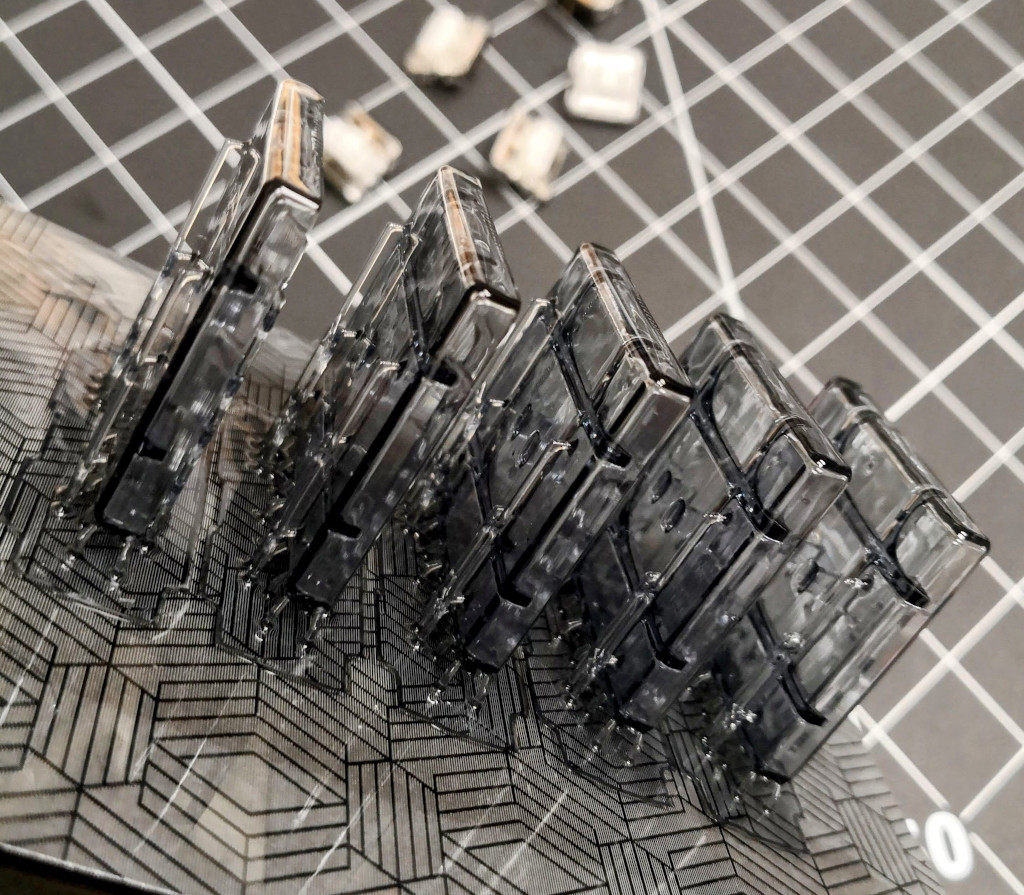
<p>Finally, structure and keycaps were entirely 3D-printed (with resin).</p>

<p><img src="/assets/img/blog/bbk3_3dprinting_keycaps.jpg" alt="A close-up photograph of the 3D printed keycaps" /></p>

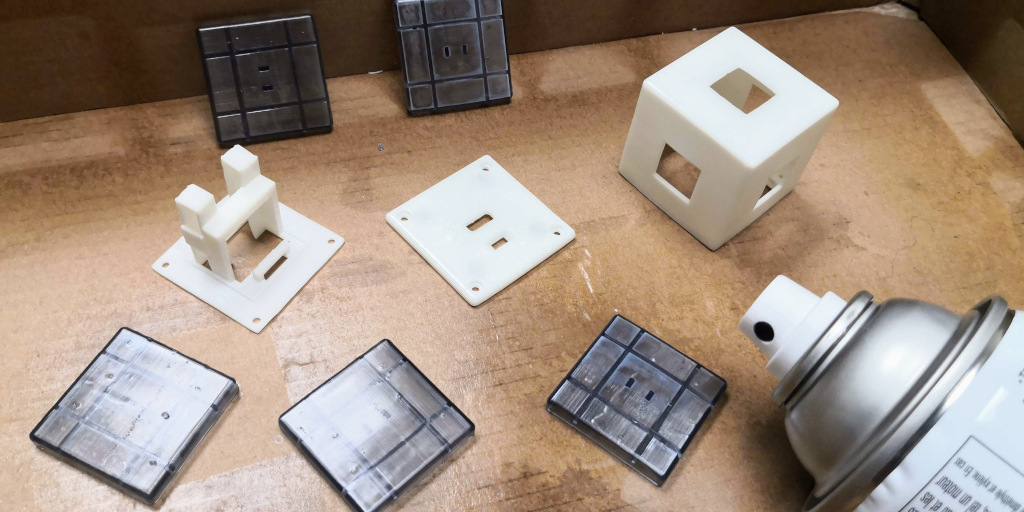
<p>… and a thin layer of clear paint was applied to any surface meant to be touched, ensuring a smoother tactile experience.</p>

<p><img src="/assets/img/blog/bbk3_painting.jpg" alt="A photograph of parts of the baby keycube being painted" /></p>

<p>For more technical details about the baby keycube, including 3D model files, sizes and a list of hardware components, visit the dedicated GitHub <a href="https://github.com/keycube/bbk3">repository</a>.</p>]]></content><author><name>Damien</name></author><category term="update" /><summary type="html"><![CDATA[The keycube family is expanding! Introducing the baby keycube (bbk3), a compact version of the original, featuring just one key per face. But it’s not just one device, it’s a pair of twins! These two units magnetically snap together to form a single, versatile controller.]]></summary></entry><entry xml:lang="en"><title type="html">Welcome to Keycube</title><link href="http://localhost:4000/update/2024/07/17/website.html" rel="alternate" type="text/html" title="Welcome to Keycube" /><published>2024-07-17T19:00:00-04:00</published><updated>2024-07-17T19:00:00-04:00</updated><id>http://localhost:4000/update/2024/07/17/website</id><content type="html" xml:base="http://localhost:4000/update/2024/07/17/website.html"><![CDATA[<p><em>(Updated on 2026-02-11)</em></p>

<p>We are excited to announce the launch of the official <strong>keycube</strong> website, your go-to destination for everything related to the keycube! Whether you’re an enthusiast, or simply curious about these innovative cubic input devices, this website is your space to explore, learn, and connect with the growing keycube community.</p>

<p>The site is designed to be user-friendly, functional, and easily accessible. Hosted on <a href="https://codeberg.page">Codeberg Pages</a> and powered by <a href="https://jekyllrb.com">Jekyll</a>, its entire source code is open and available in a public <a href="https://codeberg.org/keycube/website">repository</a>. The first version of the website and its logo were originally designed and implemented by <strong>Lucie Augier</strong> and <strong>Nina Grignola</strong> as part of an academic project (autumn 2023). Later, some elements were refined to align more closely with the Jekyll <a href="https://github.com/jekyll/minima">Minima</a> Theme, ensuring easier maintenance and updates.</p>

<p>In the spirit of transparency and community collaboration, everything about the keycube is open-source. Everyone is encouraged to contribute and track the keycube’s evolution. Don’t forget to explore the dedicated <strong>Codeberg</strong> <a href="https://codeberg.org/keycube">organization</a>, where you’ll find a range of keycube-related projects.</p>

<p>Stay engaged! Keep up with the latest updates and news by subscribing to the <a href="/feed.xml">RSS feed</a>!</p>]]></content><author><name>Damien</name></author><category term="update" /><summary type="html"><![CDATA[(Updated on 2026-02-11)]]></summary></entry></feed>